Sunday, May 31, 2009

¿Por qué es mejor comprar un libro que pedirlo prestado?

.
Fragmento del cuento Un cuento para Saroyan del libro Todos estábamos a la espera por Álvaro Cepeda Samudio:
.

"Por qué no vas a la biblioteca de la universidad y lo prestas: por qué no lees todos los libros que quieras en esa forma; todos lo hacen."
"Así no me gusta. Así no pueden gustarme los cuentos y hasta los dibujos me parecerían feos. Para que me guste un libro tiene que ser mío. En un libro de la biblioteca no podría encontrar todas las cosas que hay en los libros que yo compro. Los libros que compran las bibliotecas son escritos para los que van a leer en las bibliotecas, en cambio..."
"Pero si es la misma edición."
"No importa."
"No seas loco."
"Por qué?"
"Cómo que por qué?"
"Fíjate, por ejemplo, Faulkner le agrega páginas y personajes a sus novelas cuando uno no lo está viendo, así que cuando tú lees un libro de él por segunda vez encuentras cosas que antes no había, y es por eso: porque él agrega páginas cuando uno no está en casa. En cambio como los libros en las bibliotecas siempre están bien vigilados Faulkner no puede meterse a agregarle cosas a sus novelas."
"Ahora estás peor."
"No, Faulkner siempre está metiendo cosas nuevas en los libros que uno ha comprado. Tal vez Saroyan tenga la misma costumbre, por eso quiero comprar este libro de cuentos."
.
pp. 97-98

Wednesday, May 20, 2009

May


Average high: 88.8°F (31.6°C)
Average low: 57.4°F (14.1°C)
Relative humidity at 5 am: 34%
Relative humidity at 5 pm: 13%
Normal rainfall: .15” (3.8mm)

May will likely see the first day over 100°F (38°F) in the desert; most days will be clear, dry and hot. Many animals, humans included, begin to retreat to the mountains, where balmy days and cold but not freezing nights beckon.

Flora
Many species of Cactaceae bloom nocturnally, including saguaros, senitas, organ pipes, and queens-of-the-night, also known as night-blooming cereus. Delicate lavender blossoms open on desert ironwood and smoke trees. Desert spoon and soaptree yuccas put up tall, woody bloomstalks with white flowerettes; desert spoon is dioecious, with male or female flowers. Many red, trumpet-shaped flowers are blooming in mountain canyons as hummingbirds become more numerous and continue breeding; among the most spectucular blossoms are those of the coral bean.

Fauna
Female nectar-feeding bats, many of which are pregnant, migrate from Mexico into desert areas where nocturnally blooming plants are flowering. The two species are Mexican long-tongued and lesser long-nosed, the latter of which are endangered; they give birth in colonial maternity caves. Gila monster eggs, laid ten months ago, begin to hatch; the young lizards are perfectly formed miniature versions of their venomous parents and immediately fend for themselves. In mountain canyons, red-spotted toads are mating, filling the nights with their loud trills.

© 2006-2009 Arizona-Sonora Desert Museum

Saturday, May 16, 2009

Roberto Bolaño: Caborca y Pitiquito


"...Luego estuvimos en Caborca. Si la revista de Cesárea se llamaba así, por algo sería, dijo Belano. Caborca es un pueblo pequeño, al noroeste de Hermosillo. Para llegar allí tomamos la carretera federal hasta Santa Ana y de Santa Ana nos desviamos hacia el oeste por una carretera pavimentada. Pasamos por Pueblo Nuevo y Altar. Antes de llegar a Caborca vimos una desviación y un letrero con el nombre de otro pueblo: Pitiquito. Pero seguimos adelante y llegamos a Caborca y estuvimos dando vueltas por la municipalidad y la iglesia, hablando con todo el mundo, buscando infructuosamente a alguien que pudiera darnos noticia de Cesárea Tinajero hasta que empezó a caer la noche y volvimos a subir al carro, porque por no tener Caborca ni siquiera tenía una pensión o un hotelito en donde poder alojarnos (y si lo tenía no lo encontramos).Así que esa noche dormimos en el coche y cuando despertamos volvimos a Caborca, pusimos gasolina y nos fuimos a Pitiquito. Tengo una corazonada, dijo Belano. En pitiquito comimos muy bien y fuimos a ver la iglesia de San Diego del Pitiquito, desde afuera, porque Lupe dijo que no quería entrar y nosotros tampoco teníamos muchas ganas..."

de Los Detectives Salvajes, pp 566-567

Cormac McCarthy: Caborca

"...In three days' time he was in the town of Caborca of sacred memory. Standing there by the river squinting up in the sunshine where the dome of the broken transept of the church of La Purísima Concepción de Nuestra Señora de Caborca floated in the pure desert air..."


"...Perhaps you know the town of Caborca. The church is very beautiful. By the flooding of the river through the years much has been destroyed. The sanctuary and two bell towers. The rear of the nave and most of the south transept. What remains of it stands on three legs, so to speak. The dome hangs in the sky like an apparition and so it has hung for many years. Most improbably. No mason could devise such a structure. For years the people of Caborca waited for it to fall. It was like a thing unfinished in their lives. Events of doubtful outcome were made subject to its standing. It was said of certain old and venerable men that when they died the dome would fall and they died and their children died and the dome floated on in the pure air until at last it came to bear such import in the minds of the people of that town that they scarce would speak of it at all..."


from The Crossing, pgs. 149-150

Monday, May 11, 2009

CHAIN-FRUIT CHOLLA (opuntia fulgida)


LONGNOSE SNAKE (rhinocheilus lecontei)


Order: Squamata
Family: Colubridae (colubrid snakes)
Spanish names: coralillo


DISTINGUISHING FEATURES:
This slender snake reaches lengths of slightly over 3 feet (90 cm). While there is considerable variation in pattern and color, generally this snake is banded or blotched with black, white, and usually red; red may be entirely absent in some individuals. The belly is cream or yellowish with some dark spotting on the sides. The lower jaw is countersunk. This snake is easily confused with the venomous coral snake due to the similarity in color banding pattern. The longnose snake can be distinguished from the coral snake by its long nose, its light colored flecking on the nose (within dark fields) and by body bands that do not completely encircle the body. Additionally, color sequencing is generally different.

RANGE:
The longnose snake is found throughout the southwestern United States, in northern Baja California, and south to San Luis Potosí and southern Taumalipas in Mexico.

HABITAT:
The longnose snake is found in desertscrub, grassland, chaparral, and tropical habitats below 5400 feet (1650 m). It prefers brushy, rocky areas.

LIFE HISTORY:
When disturbed, the longnose snake writhes and twists its body, vibrates its tail, and defecates feces and blood from its anal opening. An excellent burrower if the soil is sandy, it can also retreat under rocks or into rock crevices or rodent burrows, if necessary. In warmer parts of its range, the longnose snake may lay 2 clutches of 4 to 11 eggs per year, while in cooler portions of its range only 1 egg clutch per year is laid. Active primarily at night, it feeds on many things including lizards, lizard eggs, small snakes, small mammals, and sometimes birds.

© 2006-2009 Arizona-Sonora Desert Museum

Friday, May 8, 2009

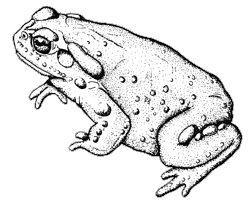
SONORAN DESERT TOAD (Bufo alvarius)


Order: Salientia
Family: Bufonidae (true toads)
Other common names: Colorado River toad
Spanish name: sapo grande


DISTINGUISHING FEATURES
At 7 inches (18 cm) or more this is one of the largest toads native to North America. Adults have a uniformly green to greenish-gray dorsum (topside of the body) and creamy white venter (underside). Large white turbercles, or “warts,”are found at the angle of the jaw, but aside from the large parotoid glands and a few large lumps on the hind legs, this species has relatively smooth skin. Recently metamorphosed toadlets will be tan to green with orange or red spots on the dorsum. Unlike other male toads in our region, male Sonoran Desert toads do not have dark throats; males develop darkened, thick callosities (calluses) on the inside of the thumbs of the forelimbs during the breeding season.


RANGE
Found from Central Arizona to southwestern New Mexico and Sinaloa, Mexico; historically entered southeastern California, though it has not been seen there since the 1970s.

HABITAT
This toad is common in the Sonoran Desert. It occurs in a variety of habitats including creosote bush desertscrub, grasslands up into oak-pine woodlands, and thornscrub and tropical deciduous forest in Mexico.

LIFE HISTORY
Sonoran Desert toads feed upon a variety of insects throughout their lives. Adults eat primarily beetles, although large individuals will occasionally eat small vertebrates including other toads. Sonoran Desert toads are active from late May to September, though principally during the summer rainy season. They are nocturnal during the hot summer months. The male’s call is weak, sounding somewhat like a ferryboat whistle. Eggs are laid in temporary rainpools and permanent ponds. Larvae metamorphose after 6 to 10 weeks. This species lives at least 10 years, and perhaps as many as 20 years.

COMMENTS
Sonoran Desert toads have extremely potent, defensive toxins that are released from several glands (primarily the paratoids) in the skin. Animals that harass this species generally are intoxicated through the mouth, nose, or eyes. Dog owners should be cautious: the toxins are strong enough to kill full grown dogs that pick up or mouth the toads. Symptoms of intoxication are excessive salivation, irregular heartbeat and gait, and pawing at the mouth. If a dog displays any of these symptoms, use a garden hose to rinse its mouth from back to front and consult a veterinarian

© 2006-2009 Arizona-Sonora Desert Museum

EL GRAN DESIERTO